
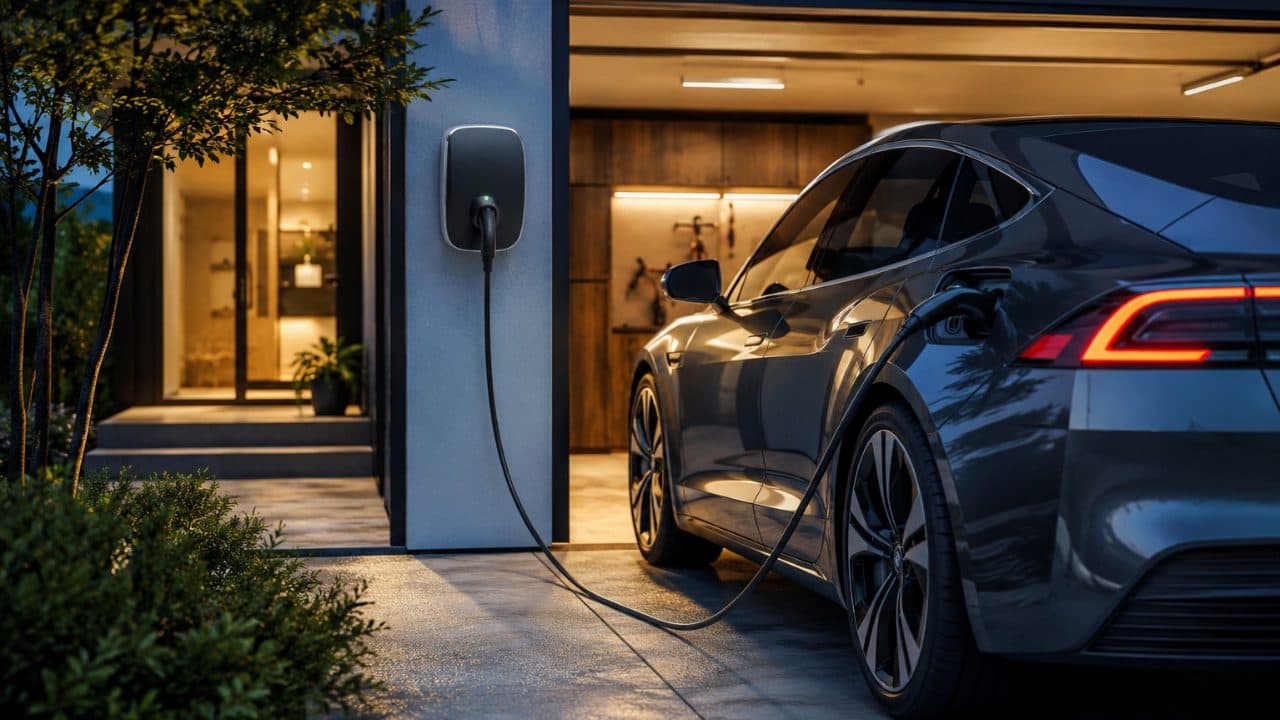
EV Home Charging Costs in the US (2026) | Complete Cost Guide
Learn how much it costs to charge an electric vehicle at home in the US in 2026. Compare charging levels, electricity rates, annual costs, and real-world savings scenarios.
- electric vehicle
- EV charging
- home EV charger
- Level 1 charging
- Level 2 charging
- EV charging costs
- electric car charging
- home charging
- electricity rates
- EV savings
- residential charging
- clean transportation
EV Home Charging Costs in the US: How Much Does It Really Cost to Charge an Electric Vehicle at Home? (2026)
26.06.2026
Introduction
Electric vehicles are no longer a niche choice in the United States. By 2026, EV adoption has expanded across almost every state, driven by lower vehicle prices, improved battery ranges, and stronger incentives for clean transportation. But one question still dominates everyday search queries from new and potential EV owners:
How much does it actually cost to charge an electric vehicle at home in the US?
The answer is not one fixed number. It depends on electricity rates, battery size, driving habits, charger type, and even the time of day you plug in. For many drivers, home charging is still significantly cheaper than gasoline. However, the real savings vary more than most people expect.
In this guide, we’ll break down everything in simple, practical terms—no technical jargon, no marketing fluff. You’ll see real cost examples, daily usage scenarios, and realistic annual spending estimates based on US electricity prices in 2026.
1. How EV Home Charging Works
Home EV charging is essentially the process of converting household AC electricity into usable energy stored in your vehicle’s battery. When you plug your EV into a home outlet or charger, electricity flows into the onboard charger, which regulates how fast and efficiently the battery is filled.
There are two main ways people charge at home:
- Standard wall outlet (Level 1 charging)
- Dedicated home charger (Level 2 charging)
The difference between them is not just speed—it also affects convenience, efficiency, and long-term energy planning.
Most EV owners in the US eventually move toward Level 2 charging because it aligns better with daily driving needs.
2. Level 1 vs Level 2 Charging Explained
Level 1 Charging (120V Standard Outlet)
This is the simplest setup: plug your EV into a regular household outlet.
Key characteristics:
- Charging speed: ~3–5 miles of range per hour
- Best for: low-mileage drivers
- Installation cost: $0 (usually)
- Efficiency: slightly lower due to longer charging times
Level 1 charging works well if you drive under 30–40 miles per day. But for most households, it feels slow and limiting.
Level 2 Charging (240V Home Charger)
Level 2 charging requires a dedicated installation, similar to an electric dryer or oven outlet.
Key characteristics:
- Charging speed: ~20–45 miles of range per hour
- Full charge time: 4–10 hours depending on battery size
- Installation cost: $500–$2,000 (average in US homes)
- Efficiency: higher and more stable
Level 2 is the standard for most EV owners in 2026 because it enables “overnight refueling”—you plug in at night and wake up with a full battery.
3. Average Electricity Costs in the US (2026)
Electricity prices in the United States vary significantly by state. As of 2026, the average residential electricity rate is approximately:
$0.16 – $0.24 per kWh
However, real-world variation looks like this:
- Low-cost states: $0.10–$0.14/kWh
- Average states: $0.15–$0.20/kWh
- High-cost states: $0.21–$0.30+/kWh
This variation is the single biggest factor affecting EV charging costs.
Two drivers with identical vehicles can easily have 30–60% difference in monthly charging bills just based on location.
4. Real Cost Per kWh for EV Owners
EV charging is measured in kilowatt-hours (kWh), not gallons.
To estimate real cost, we use:
Cost per kWh = your electricity rate
Example:
- If your rate is $0.18/kWh
- And your EV uses 60 kWh battery capacity
Then:
Full charge cost = 60 × 0.18 = $10.80
But most drivers don’t fully drain and recharge daily. Instead, they top up.
So real daily cost depends on mileage:
- 30 miles/day → ~$1.50–$3.00
- 50 miles/day → ~$2.50–$5.00
- 100 miles/day → ~$5.00–$10.00
5. How Much It Costs to Fully Charge an EV
Let’s use real EV examples:
Small EV (40 kWh battery)
- Cost: $6 – $10 in most US states
Mid-size EV (60–75 kWh battery)
- Cost: $9 – $18
Large EV SUV (90–120 kWh battery)
- Cost: $14 – $30+
Even at the high end, a full charge is usually cheaper than a full tank of gasoline in 2026.
6. Monthly and Annual Charging Costs
Now let’s convert this into real-life ownership costs.
Average US driver (12,000–15,000 miles/year)
Assuming:
- Efficiency: 3–4 miles per kWh
- Electricity: $0.18/kWh
Annual cost range:
- Low usage EV: $400 – $600/year
- Average driver: $600 – $1,000/year
- High mileage driver: $1,200 – $1,800/year
Compare that to gasoline vehicles:
- Average gas car: $1,800 – $3,500/year (fuel only)
EVs usually save 30% to 70% on energy costs, depending on location and driving habits.
7. Real-World Driving Cost Scenarios
Scenario 1: City commuter
- 25 miles/day
- Charging at home Level 2
- Monthly cost: ~$40–$60
Scenario 2: Suburban family
- 50 miles/day
- Mixed charging schedule
- Monthly cost: ~$70–$120
Scenario 3: High-mileage driver
- 100+ miles/day
- Heavy EV use
- Monthly cost: ~$150–$300
Even in high-use scenarios, EVs remain significantly cheaper than gasoline equivalents.
8. Factors That Affect Your Charging Bill
Your EV charging cost is influenced by more than just electricity price:
- Battery size (kWh capacity)
- Vehicle efficiency (miles per kWh)
- Driving style (aggressive vs smooth)
- Weather (cold reduces efficiency)
- Charging losses (~5–12%)
- Time of charging (peak vs off-peak rates)
Cold climates like northern US states can increase energy consumption by up to 20–30% in winter months.
9. Time-of-Use Pricing and Smart Charging
Many US utility companies now offer time-of-use (TOU) pricing.
This means:
- Night charging: cheaper ($0.08–$0.14/kWh in some areas)
- Peak hours: expensive ($0.25–$0.40/kWh)
Smart chargers or EV apps can automatically schedule charging at the cheapest times.
This alone can reduce annual charging costs by 15–40% without changing driving habits.
10. Home Charging vs Public Charging Costs
One of the biggest misconceptions among new EV owners is that all charging is cheap. In reality, where you charge matters just as much as how you charge.
Home charging remains the most cost-effective option in nearly every case. Public charging, especially fast DC charging, can be significantly more expensive.
Home Charging (Baseline Cost)
As we covered in Part 1:
- Average cost: $0.10 – $0.24 per kWh
- Typical full charge: $8 – $25
- Predictable and stable pricing
- Overnight convenience
Home charging is essentially your “default fuel station” once you install Level 2 charging.
Public Level 2 Charging
These are chargers found in:
- shopping centers
- workplaces
- parking garages
- hotels
Cost range:
- $0.20 – $0.40 per kWh
- or flat hourly rates ($2–$6/hour)
This is usually slightly more expensive than home charging, but still reasonable for topping up during the day.
DC Fast Charging (High-Speed Public Charging)
This is where costs increase significantly.
- $0.40 – $0.70 per kWh (sometimes higher)
- $15 – $40 for a partial charge
- Convenience-driven pricing
Fast charging is designed for:
- long-distance travel
- emergencies
- road trips
Not for daily use.
Real Comparison Example
Let’s assume a 70 kWh battery EV:
- Home charge: ~$12–$15
- Public Level 2: ~$18–$28
- DC fast charge: ~$30–$50
Over a month, relying on fast charging can easily double or triple your energy costs.
11. Break-Even Analysis: Is Home Charging Worth It?
Installing a Level 2 home charger typically costs:
- $500 – $2,000 (installation included)
Now compare savings:
If you save:
- $80/month vs public charging
- $1,000/year in fuel costs vs gasoline
Then:
Break-even point:
- Typically 6–24 months
In most US households, the charger pays for itself within the first 1–2 years.
After that, it becomes pure savings.
12. Hidden Costs of Home EV Charging
While EV charging is cheaper than gasoline, there are a few hidden factors many people ignore.
1. Electrical Panel Upgrade
Some older homes need upgrades to support Level 2 charging.
- Cost: $500 – $3,000+
- Required if panel is under 100–150 amps
2. Installation Complexity
Costs vary depending on:
- distance from panel to garage
- wall drilling or trenching
- indoor vs outdoor setup
A simple install may cost $500, but complex setups can exceed $2,000.
3. Electricity Plan Changes
Some utilities require:
- special EV tariffs
- time-of-use plans
This can be beneficial, but also requires behavior adjustment (charging at night).
4. Charging Efficiency Loss
Not all electricity reaches your battery.
- Typical loss: 5–12%
- Higher in cold weather
- Higher with older chargers
This means your real cost is slightly higher than raw kWh math suggests.
13. Real-Life Monthly Budget Examples
Let’s break down realistic EV charging budgets in 2026.
Example 1: Budget-Conscious Driver (Low Mileage)
- 8,000 miles/year
- Mostly home charging
- Off-peak electricity
Monthly cost:
- $25 – $50
This is comparable to a single tank of gas per month in many US vehicles.
Example 2: Average Household EV Owner
- 12,000–15,000 miles/year
- Mixed driving conditions
- Mostly home charging
Monthly cost:
- $60 – $120
Still significantly cheaper than gasoline equivalents.
Example 3: High-Usage EV Driver
- 20,000+ miles/year
- Frequent commuting or rideshare use
- Occasional fast charging
Monthly cost:
- $150 – $300+
Even at this level, EVs often remain cheaper than gas-powered SUVs.
14. How Weather Impacts Charging Costs
Weather is one of the most overlooked cost factors.
Cold Weather Effects
In colder US states:
- Battery efficiency drops by 15–30%
- Heating cabin consumes extra energy
- Charging speed may slow down
This leads to:
- higher kWh consumption per mile
- slightly higher monthly bills
Hot Weather Effects
Less severe, but still relevant:
- AC usage increases energy consumption
- Battery cooling systems activate more frequently
Overall impact:
- 5–10% increase in energy use
15. Everyday Use Cases: How People Actually Charge
Let’s look at how EV owners realistically use home charging.
Case 1: Overnight Routine
Most common scenario:
- Plug in at 9–11 PM
- Wake up with 80–100% battery
- No daily charging stress
This is the “set and forget” model.
Case 2: Weekly Top-Up
Some drivers don’t plug in daily.
- Charge 1–2 times per week
- Similar to refueling a gas car once a week
- Works well for low-mileage drivers
Case 3: Hybrid Charging Lifestyle
Common in urban areas:
- Home charging during weekdays
- Public charging during travel or work
- Occasional fast charging on long trips
16. Long-Term Cost Perspective (5–10 Years)
EV charging costs are not just monthly—they accumulate over years.
Let’s compare:
EV (home charging average)
- $800/year × 10 years = $8,000
Gasoline vehicle
- $2,200/year × 10 years = $22,000
Even without incentives, EVs often save:
- $10,000 – $15,000+ over a decade
And this does not include:
- oil changes
- engine maintenance
- transmission servicing
17. How to Reduce Your EV Home Charging Costs (Optimization Strategies)
At this point, you already know EV home charging is generally cheaper than gasoline and public charging. But there’s still a lot of room to optimize your costs further—sometimes more than people expect.
Here are the most effective strategies in real-world use.
1. Charge During Off-Peak Hours
This is the single most important cost-saving strategy.
Most US utility companies offer time-of-use (TOU) pricing:
- Off-peak (night): $0.08 – $0.14/kWh
- Peak (day/evening): $0.25 – $0.40/kWh
What this means in practice:
If you charge 90% of the time at night instead of peak hours, you can reduce annual charging costs by 20–50%.
2. Use Smart Charging Features
Most modern EVs and home chargers allow scheduling.
You can:
- set charging windows (e.g., 1 AM – 6 AM)
- automatically avoid peak pricing
- optimize charging speed based on electricity rates
Some systems even integrate with utility pricing in real time.
3. Avoid Frequent DC Fast Charging
Fast charging is convenient—but expensive.
If you rely on it often:
- your cost per mile can double
- battery degradation may increase slightly over time
Best practice:
- use fast charging only for trips or emergencies
- keep daily charging at home whenever possible
4. Keep Battery Between 20–80% for Daily Use
You don’t need to charge to 100% every day.
Benefits:
- improves long-term battery health
- reduces unnecessary energy cycles
- slightly improves charging efficiency
Most drivers find a daily 70–80% routine is enough.
5. Improve Home Energy Efficiency
Your EV charging cost is part of your total home electricity bill.
Reducing household consumption helps indirectly:
- LED lighting
- efficient appliances
- better insulation
- smart thermostats
Lower home usage = lower marginal impact from EV charging.
6. Consider Solar (Optional Upgrade)
If you already have or plan solar:
- EV charging cost can drop close to $0 marginal cost
- daytime charging becomes essentially free
- long-term ROI improves significantly
Even partial solar coverage can offset 30–70% of EV energy needs.
7. Choose the Right Electricity Plan
Some utilities offer EV-specific tariffs:
- cheaper overnight rates
- special EV meter programs
- bundled charging incentives
This alone can save $100–$400 per year depending on usage.
18. Advanced Smart Charging Strategies (2026)
As EV infrastructure improves, charging is becoming more automated and intelligent.
Dynamic Pricing Optimization
Some newer systems adjust charging automatically based on:
- real-time grid demand
- electricity price fluctuations
- renewable energy availability
This means your EV charges when energy is cheapest and cleanest.
Load Balancing at Home
If you have multiple high-energy devices:
- EV charger
- HVAC system
- electric appliances
Smart systems prevent overload by:
- reducing EV charging speed temporarily
- prioritizing essential household loads
This avoids peak demand charges in some regions.
AI-Based Charging Optimization (Emerging Trend)
Some EV platforms now use AI to:
- predict your driving schedule
- estimate required range
- minimize unnecessary charging sessions
In practice, this reduces wasted energy cycles and improves cost efficiency.
19. 8 Frequently Asked Questions (FAQ)
1. Is it cheaper to charge an EV at home or at a station?
Home charging is almost always cheaper. On average, it costs 40–70% less than public fast charging.
2. How much does it cost to charge an EV per month?
Most US drivers spend:
- $40 – $120/month for normal usage
High-mileage drivers may reach $150 – $300/month.
3. Does charging an EV increase my electricity bill a lot?
It increases it, but not dramatically. For most households, EV charging adds $50–$100 per month on average.
4. How long does a home EV charger installation take?
Typically:
- 2–6 hours for simple installations
- 1–2 days for complex electrical upgrades
5. Can I charge my EV using a normal outlet?
Yes, but it’s slow. Level 1 charging adds only 3–5 miles of range per hour.
6. Does fast charging damage the battery?
Occasional use is fine. Frequent fast charging can slightly accelerate battery wear over many years.
7. What is the cheapest time to charge an EV?
Usually overnight:
- between 11 PM and 6 AM
This is when electricity demand is lowest.
8. Is EV charging still cheaper than gasoline in 2026?
Yes. In most US regions, EVs cost 30–70% less to “fuel” than gasoline vehicles.
20. Conclusion
Home EV charging in the United States in 2026 is still one of the most cost-effective ways to power a vehicle.
While exact costs vary depending on electricity rates, driving habits, and charger type, the overall pattern is clear:
- Home charging is the cheapest and most convenient option
- Public charging is significantly more expensive
- Fast charging is best reserved for travel, not daily use
- Smart charging strategies can reduce costs even further
For most drivers, switching to an EV with home charging results in meaningful long-term savings—often thousands of dollars over the lifespan of the vehicle.
The key is not just owning an EV, but charging it intelligently.
Related reading
 EV Ownership in 2026: Maintenance, Costs, Charging & Real Economics (USA Guide)
A detailed 2026 guide to EV ownership in the USA covering maintenance, charging costs, electricity pricing, battery degradation, and real-world operating economics compared to gasoline vehicles.
 Will Electric Cars Still Be Worth It in 2027? Cost Breakdown vs Gasoline
A full cost breakdown of electric cars vs gasoline in 2027. Compare charging costs, fuel prices, maintenance, depreciation, and total ownership costs to see if EVs are still worth it.
 Best Home Insulation Upgrades for Maximum Energy Savings (2026)
Discover the best home insulation upgrades in 2026 that cut heating and cooling costs, improve comfort, and deliver the fastest ROI across different US climate zones.